
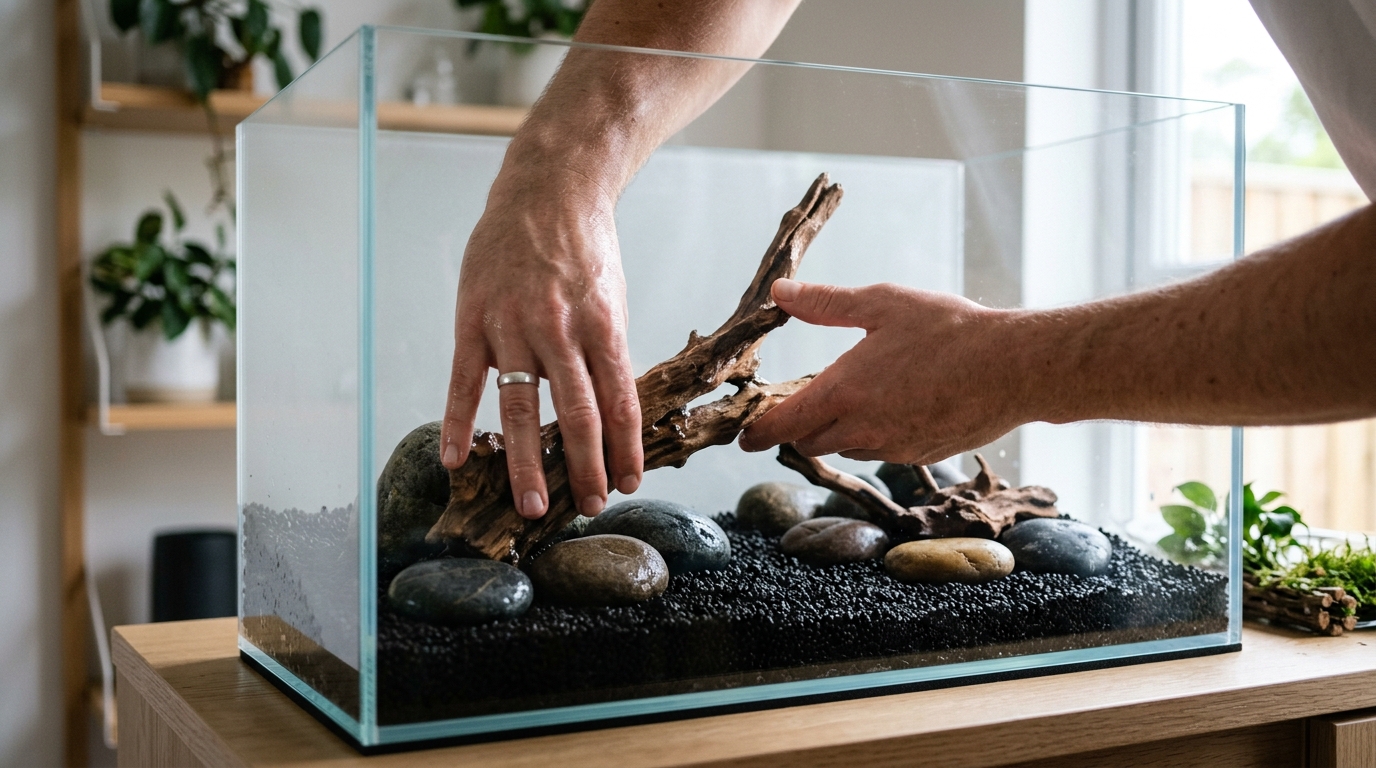
One of the most frequent surprises for new aquascapers is discovering that many of the most resilient, beginner-friendly live plants must never be buried into substrate. Species like Anubias, Java Fern, and Bucephalandra are natural epiphytes. In their native river ecosystems, they do not root into thick mud; instead, their modified stems grip hard submerged rocks, tangled tree roots, and waterlogged timber. Learning how to properly anchor these plants to hardscape creates breathtaking three-dimensional aquascapes while keeping your plants healthy and rot-free.
- Best Epiphyte Plants for Hardscape Attachment
- Method 1: The Cyanoacrylate Gel Glue Technique (Fastest & Most Reliable)
- Method 2: The Cotton Sewing Thread Technique (100% Natural & Biodegradable)
- Method 3: Clear Fishing Line or Small Cable Ties (For Heavy Specimens)
- Comparison of Hardscape Mounting Methods
- Long-Term Nutrition for Epiphytes
- Frequently Asked Questions
Best Epiphyte Plants for Hardscape Attachment
Before selecting your mounting method, identify whether your chosen species is an epiphyte. The following varieties excel when bound to wood and stone:
- Anubias Species: Including Anubias barteri var. nana, Anubias petite, and Anubias coffeefolia. Renowned for thick waxy leaves and virtually indestructible rhizomes.
- Java Fern (Microsorum pteropus): Available in regular, Windeløv (crested), needle leaf, and trident varieties. Excellent background and midground fillers that produce daughter plantlets along leaf margins.
- Bucephalandra: Prized for iridescent blues, deep purples, and compact growth habits. Native to fast-flowing rivers of Borneo with powerful cling-roots.
- Aquatic Mosses: Java moss, Christmas moss, and weeping moss form lush green carpets over gnarly wood branches.
- African Water Fern (Bolbitis heudelotii): Elegant, translucent green fronds that love moderate to high water flow around rock crevices.
Method 1: The Cyanoacrylate Gel Glue Technique (Fastest & Most Reliable)
Using adhesive inside an aquarium sounds intimidating to beginners, but cyanoacrylate-based gel glue is 100% fish-safe, inert once cured, and the industry standard among professional aquascapers.
Required Supplies:
- Standard Ethyl Cyanoacrylate Gel (look for gel formulations; liquid runs everywhere and cures uncontrollably).
- Clean paper towels.
- Sharp aquascaping tweezers or scissors.
Step-by-Step Instructions:
- Remove the Hardscape (If Possible): While you can apply glue underwater, securing plants outside the tank on a damp towel offers ten times better precision and bond strength.
- Pat Dry the Contact Points: Use a clean paper towel to dab moisture off the rock or wood surface where you plan to mount the plant. Also dab dry the underside of the plant rhizome. Surfaces do not need to be bone-dry—cyanoacrylate actually polymerizes upon contact with minor moisture.
- Apply a Tiny Pea-Sized Dab: Place one small drop of gel glue directly onto the stone or wood surface. Avoid slathering large quantities, which create unsightly white residue.
- Press and Hold for 20 Seconds: Gently press the rhizome into the glue dab. Hold steady pressure for 15 to 20 seconds.
- Mist with Water: Spray the plant and hardscape with clean conditioned tank water to trigger complete curing, then return the piece to your aquarium.
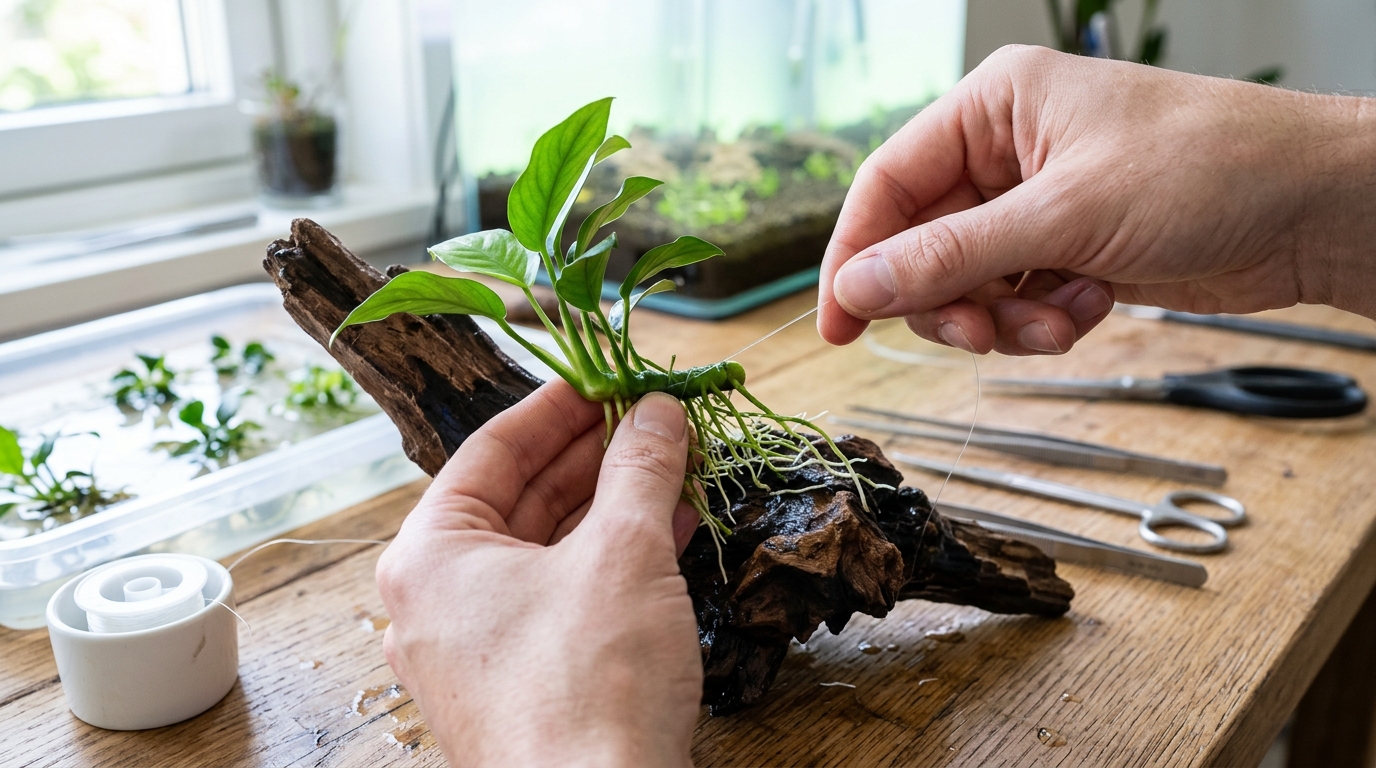
Method 2: The Cotton Sewing Thread Technique (100% Natural & Biodegradable)
If you prefer an organic, chemical-free technique, plain 100% cotton sewing thread is the traditional method favored by Takashi Amano and nature aquarium pioneers.
Step-by-Step Instructions:
- Choose Dark Thread: Pick dark green, black, or dark brown cotton thread to blend invisibly with moss, wood bark, or basalt rocks. Avoid nylon or polyester thread if you want the string to dissolve naturally.
- Position the Rhizome: Place the plant against a natural crevice or curve of the driftwood branch where water currents flow naturally.
- Wrap Snugly but Gently: Wind the thread around the branch and over the rhizome 4 to 6 times. Apply enough tension to hold the plant firmly in place, but do not pinch or slice into the living rhizome tissue.
- Tie Off with a Double Knot: Secure the ends with a neat surgeon's knot and snip the excess tails with scissors.
- Natural Degradation: Within 4 to 8 weeks, the cotton thread gradually breaks down in the water. By the time the thread dissolves, the plant's adventitious roots have firmly gripped the microscopic fissures in the wood.
Method 3: Clear Fishing Line or Small Cable Ties (For Heavy Specimens)
Large mother plants of Java Fern or massive Anubias specimens have buoyant foliage that can pull free from cotton thread before roots establish.
- Monofilament Fishing Line (2 to 4 lb test): Extremely thin and virtually invisible under aquarium lighting. Unlike cotton, nylon fishing line will never decompose, providing permanent mechanical anchoring. Once roots attach, you can easily snip the line with fine-point scissors and pull it free.
- Mini Black Cable Zip Ties: Outstanding for thick driftwood branches. Fasten the zip tie loosely around the rhizome, pull snug, trim the excess tab flush, and rotate the square head into an unseen crevice.
Comparison of Hardscape Mounting Methods
| Method | Best Used For | Pros | Cons |
|---|---|---|---|
| Cyanoacrylate Gel Glue | Stones, tiny crevices, Bucephalandra, Anubias nana petite | Instant bond (30 seconds), rock-solid hold, works on sheer stone faces | Turns chalky white if over-applied; permanent until cut |
| Cotton Thread | Moss carpets, thin driftwood branches, small Anubias | Naturally decomposes; leaves zero synthetic residue; zero chemical risk | Can rot before roots grip if water has high microbial activity |
| Clear Fishing Line | Heavy Java Fern mother plants, buoyant wood sections | Invisibly clear; indestructible mechanical hold | Must be manually cut and removed later to avoid snagging bottom fish |
| Natural Crevice Wedging | Rough lava rock, knotty Mopani wood, dragon stone cavities | Zero materials needed; 100% natural; completely invisible | Can dislodge during siphon water changes or by boisterous fish |
Long-Term Nutrition for Epiphytes
Because epiphytes are suspended in the water column rather than embedded in nutrient-dense substrate, they extract nearly all their essential macro and micronutrients directly from the surrounding water.
- Liquid All-in-One Fertilizer: Dose a balanced freshwater plant fertilizer containing potassium, iron, and trace minerals once or twice weekly according to bottle instructions.
- Avoid Intense Direct Lighting: Slow-growing species like Anubias and Bucephalandra are susceptible to black beard algae (BBA) and green spot algae under excessive illumination. Position them under the dappled shade of taller stem plants or floating surface vegetation.
- Water Movement: Gentle, steady water flow delivers dissolved CO2 and vital minerals directly across leaf surfaces while preventing organic debris from settling on their foliage.
Frequently Asked Questions
Is regular Krazy Glue or Gorilla Glue safe for aquarium fish?
Yes, provided the active ingredient is 100% Ethyl Cyanoacrylate and it is labeled as a Gel formula. Avoid products containing plasticizers, accelerators, or rubber-toughened additives. Standard cyanoacrylate polymerizes rapidly upon contact with moisture, becoming completely inert, non-toxic, and safe for fish, snails, and sensitive dwarf shrimp.
How long does it take for Anubias roots to grip driftwood?
Depending on water chemistry, lighting, and available dissolved nutrients, Anubias and Java Fern typically take between 3 to 6 weeks to send fine anchor roots deep into the porous crevices of driftwood and lava stone. Once attached, you can safely remove any temporary fishing line or zip ties.
Can I attach aquarium moss and Anubias to artificial resin decor?
Yes, though smooth glazed plastic resin decor provides less physical grip than porous natural materials like lava rock or spiderwood. Using cyanoacrylate gel glue is the most dependable method when mounting plants to artificial ornaments or smooth river stones.
Recommended Related Guides & Resources:
Continue building your freshwater fishkeeping knowledge with our related walkthroughs:
- Explore our comprehensive guide on betta fish care guide.
- Check out our essential walkthrough on how to clean a fish tank safely.
Educational reference: Consult official botanical biology of freshwater epiphyte plants for deeper biological background.