





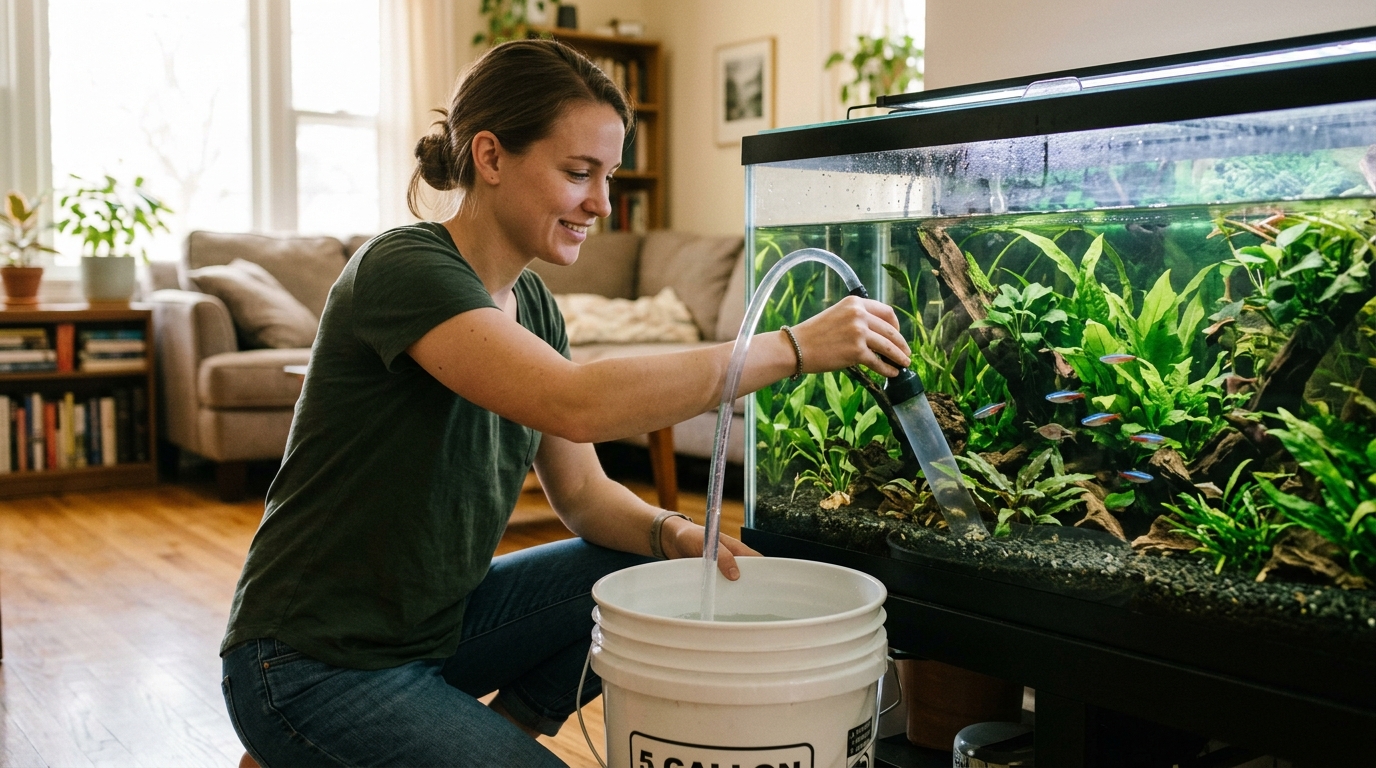
Maintaining clear, healthy water is the foundation of long-term fishkeeping success, yet one question sparks endless debate among newcomers: how often should you change aquarium water? Some beginners assume that a high-tech filter eliminates the need for water changes entirely, while others change half the tank every two days out of anxiety. The truth lies in finding a predictable, balanced rhythm tailored to your tank’s unique size, fish population, and biological load. In this comprehensive guide, we will break down the science of water renewal, examine how nitrates accumulate, and provide practical testing benchmarks so you always know exactly when and how much water your aquarium needs.
Key Takeaways & Quick Reference
- Baseline Standard: A 20% to 25% water change once per week is ideal for most freshwater community tanks.
- The Nitrate Threshold: Use a liquid drop kit to keep nitrates reliably under 20 ppm; if nitrates exceed 40 ppm, a change is needed immediately.
- Evaporation Myth: Simply topping off evaporated water does not remove nitrates or waste—it concentrates them. Always siphon out old water.
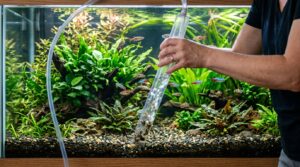
- Technique Guide: Pair your schedule with our step-by-step instructions on cleaning an aquarium without removing fish.
Why Filters Cannot Replace Regular Water Changes
To understand why water changes are irreplaceable, you must understand how your aquarium’s biological filter functions. In a cycled aquarium, beneficial bacteria perform an invaluable service by converting highly toxic fish waste (ammonia) into nitrite, and then transforming nitrite into nitrate. While nitrate is far less toxic than ammonia, it does not disappear on its own in a standard freshwater setup.
Over days and weeks, nitrate continuously accumulates in the closed volume of your tank. In nature, rivers and streams benefit from millions of gallons of rainfall and constant flow, diluting waste compounds infinitely. In a home aquarium, the only practical way to export accumulated nitrates, trace hormones, dissolved organic carbons, and microscopic debris is by physically removing a portion of old water and replacing it with clean, dechlorinated freshwater.
The General Rule: Finding Your Baseline Schedule
For the vast majority of community freshwater aquariums, the gold standard recommendation is performing a 20% to 25% water change once every week or once every two weeks for very lightly stocked tanks. This modest partial change refreshes essential minerals, keeps nitrate levels safely below 20 parts per million (ppm), and avoids causing sudden shock to fish physiology.
However, your exact answer to how often should you change aquarium water depends heavily on four key variables:
- Tank Volume: Smaller aquariums (5 to 10 gallons) hold less water volume, meaning waste concentrates much faster than in a 40-gallon tank. Small nano setups require strict weekly maintenance.
- Stocking Density: A 20-gallon tank with six small Neon Tetras produces very little biological waste compared to the same tank housing three messy adult goldfish. Heavy bioloads demand weekly changes.
- Presence of Live Plants: Live aquatic plants absorb nitrate and ammonia as natural fertilizers, naturally extending the stability of the water between changes.
- Feeding Habits: Overfeeding introduces excess protein and phosphates that break down into nitrates rapidly, requiring more frequent water renewal.

Using Nitrate Testing to Create a Custom Schedule
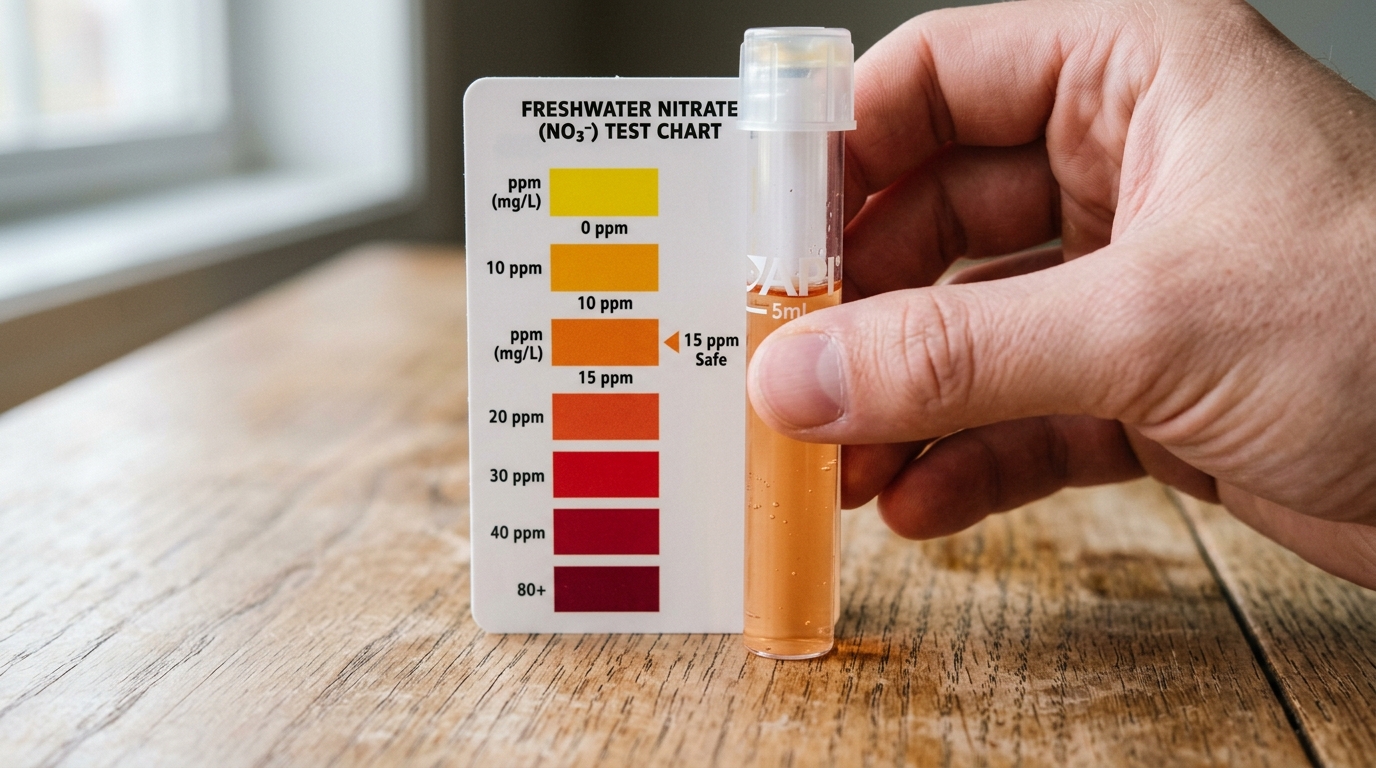
Rather than guessing on the calendar, the most scientific way to determine your personal maintenance routine is using a liquid freshwater master test kit. Nitrates are the most reliable biological indicator of overall water freshness in an established aquarium.
Here is how to calibrate your water change schedule using nitrate testing:
- Target Nitrate Level (Under 20 ppm): This is the ideal target for most freshwater tropical fish and sensitive invertebrates like ornamental shrimp.
- Caution Range (20 to 40 ppm): Acceptable for very hardy species, but an indicator that a 25% water change is due within the next 24 to 48 hours.
- Action Range (Above 40 ppm): Prolonged exposure to levels above 40 ppm causes chronic stress, dulls fish colors, and fuels heavy nuisance algae blooms. A 30% to 40% change is needed immediately.
Test your tank water once every five days for two weeks without changing water. When your test tube turns orange indicating 20 ppm, you have found your tank’s natural threshold. If it takes seven days to reach 20 ppm, your schedule is weekly. If it takes fourteen days, a bi-weekly routine is appropriate.
| Aquarium Setup | Water Volume | Recommended Frequency | Change Amount |
|---|---|---|---|
| Nano Betta Tank | 5 Gallons | Once every 5 to 7 days | 20% to 25% |
| Standard Community Tank | 10 – 20 Gallons | Once every 7 days | 20% to 25% |
| Heavily Planted Tank | 20 – 40 Gallons | Once every 7 to 14 days | 15% to 20% |
| High Bioload Tank (Goldfish/Cichlids) | 30+ Gallons | Once every 5 to 7 days | 30% to 40% |
How Much Water to Change: 15% vs 25% vs 50% Explained
Choosing the correct percentage of water to remove is just as crucial as the frequency. Different situations call for distinct approaches:
- 15% to 20% (Light Refresh): Ideal for heavily planted low-tech aquariums with light fish stocking. Keeps mineral levels replenished without disrupting delicate plant roots.
- 25% to 30% (Standard Maintenance): The sweet spot for typical community tanks. Effectively halves accumulated nitrates without shifting total water chemistry significantly.
- 50% (Emergency Only): Reserved strictly for accidental overfeeding, medication removal, or accidental tap water contamination. Changing 50% or more requires extreme precision in temperature and pH matching to prevent osmotic shock.
Common Water Change Mistakes Beginners Make
While figuring out how often should you change aquarium water, keeping these critical mistakes in mind will protect your aquatic pets from unnecessary stress:
- Just “topping off” evaporated water: When water evaporates, only pure H2O leaves the tank; minerals, hardness salts, and nitrates stay behind. Merely topping off without siphoning out old water causes mineral hardness and nitrates to climb dangerously high.
- Forgetting to dechlorinate tap water: Always dose water conditioner before or while adding new tap water to neutralize chlorine immediately.
- Drastic temperature mismatches: Adding water that is 5°F warmer or colder than the tank can trigger thermal shock in sensitive fish species.
- Waiting until water smells or looks dirty: Toxic compounds like ammonia, nitrite, and nitrate are completely invisible and odorless. By the time water appears dirty or cloudy, fish have already been under stress for days.
Frequently Asked Questions (FAQ)
Can I change 100% of my aquarium water if it looks dirty?
Never change 100% of the water. Replacing all the water alters pH, mineral hardness, and temperature abruptly, inducing lethal osmotic shock in fish. Always stick to gradual 20% to 30% partial changes.
Why does water testing matter more than relying on a calendar schedule?
Because fish produce invisible waste, water that looks clear can still carry dangerously high nitrate levels. Liquid testing provides objective measurements so you never under-maintain or over-maintain your aquarium.
Do live plants change how often I need to do water changes?
Yes! Fast-growing plants like floating Frogbit, Hornwort, and stem plants consume nitrates as food, naturally slowing nitrate buildup and keeping water clean longer.
Conclusion
Establishing a dependable routine answers the age-old question of how often should you change aquarium water once and for all. For most hobbyists, dedicating twenty minutes every weekend to a gentle 20% to 25% partial water change keeps the aquatic environment stable, fresh, and thriving. By pairing consistent water changes with occasional nitrate testing, you create a vibrant, healthy ecosystem where your freshwater fish can live long, colorful, and active lives.
Recommended Related Guides & Resources:
Continue building your freshwater fishkeeping knowledge with our related walkthroughs:
- Explore our comprehensive guide on how to clean a fish tank safely.
- Check out our essential walkthrough on planted aquarium setup for beginners.
Educational reference: Consult official aquatic water chemistry standards for deeper biological background.


